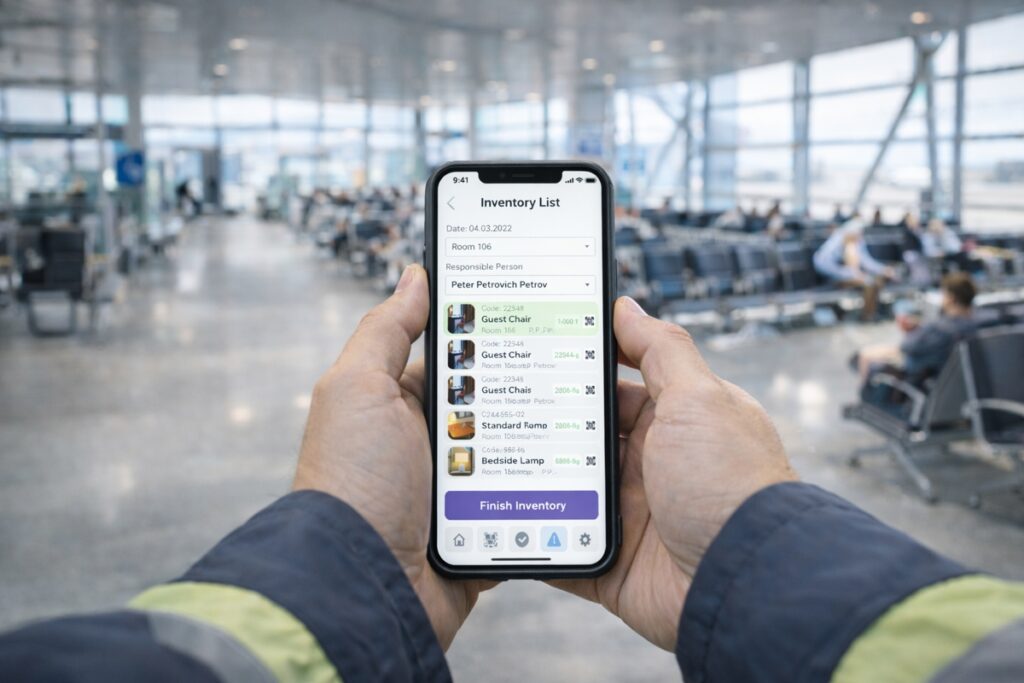
Airport Asset Tracking

Case Study: Airport Asset Tracking in a Closed Network with Android Mobile Inventory (10,000+ Assets)
Client profile and operational context
The client is an airport operating a distributed infrastructure with a large volume of assets spread across terminals, technical areas, warehouses, administrative zones, and airside facilities. The asset base includes technological equipment, ground support and maintenance tools, IT hardware, engineering systems, and operational inventory used by multiple departments and shifts.
In this environment, airport asset tracking is not only about knowing what the airport owns. It is about ensuring assets are physically present where they should be, assigned to the right responsible teams, and verified on schedule—without disrupting operations. The airport needed a standardized approach that could scale, remain secure, and provide management-level visibility into inventory progress and results.
Key needs
The client’s priorities were clear:
- Conduct regular inventory of airport property and technological equipment.
- Plan inventories by location, department, and time period.
- Control on-time completion of inventory tasks and reduce delays.
- Maintain a reliable, up-to-date asset register as a single source of truth.
Project constraints and initial conditions
The implementation started with two critical factors:
Scale: the airport managed more than 10,000 accounting units (assets).
Existing labeling: assets already had barcode labels applied, which removed the need for a separate tagging phase and allowed the project to focus on process and technology.
The primary constraint was information security:
- The airport operates a closed network with no Internet access.
- Inventory is performed using Android mobile phones.
- Phones connect only to a dedicated Wi-Fi network without Internet, but with access to the internal server hosting the QR asset system.
This meant cloud services and external identity providers were not an option. The solution had to work fully within the airport’s perimeter, comply with internal security policies, and still deliver a convenient mobile workflow.
Implemented solution
The airport deployed the enterprise (corporate) version of QR Asset Accounting (QR Inventory) on its own servers. Inventory execution was moved to the QR Inventory mobile application for Android, adapted specifically for operation inside a closed network.
To ensure encrypted and trusted communication inside the perimeter, the project included an internal PKI approach:
- The HTTPS/SSL certificate was issued by the airport’s internal certificate authority.
- The internal CA certificate chain was installed on Android devices.
- Mobile-to-server communication ran securely over HTTPS without certificate errors.
This architecture provided secure access within the dedicated Wi-Fi network while preserving the simplicity of mobile scanning.
How the process works: from planning to verified results
The airport’s goal was not “scanning for the sake of scanning.” The objective was to turn airport asset tracking into a controlled, repeatable operational process with planning, assignments, and measurable execution.
Asset register preparation and structure
The asset database was organized with a practical operational structure: departments, zones/rooms, responsible persons, asset categories, and status fields. Existing barcodes were used as the fast identifier for each asset, enabling instant lookup during inventory.
Inventory planning
Inventory campaigns were planned by:
- terminal zones and support areas,
- technical rooms and engineering facilities,
- warehouses and maintenance workshops,
- department ownership and responsibility boundaries.
Planning allowed the airport to distribute workload across teams and avoid peak operational disruptions.
Task assignment and deadline control
The system generated inventory tasks with deadlines, scope, and responsible executors. Supervisors could monitor progress inside the internal network:
- what is completed vs. pending,
- which zones are in progress,
- where delays occur,
- how many assets are confirmed, missing, or require investigation.
This shifted inventory from a “periodic high-stress event” to a managed workflow.
Mobile inventory on Android
Executors used Android phones connected to the dedicated Wi-Fi network:
- scan the asset barcode using the camera,
- instantly identify the asset record,
- confirm physical presence,
- update location or responsible party when necessary,
- close the task step and continue to the next item.
With 10,000+ assets, the mobile approach significantly increased throughput and reduced errors compared to manual lists or spreadsheet-based checks.
Security and operation without Internet
For airports, operating without Internet in critical environments is common. The implementation ensured the airport asset tracking process remained fully internal:
- the server is hosted on airport infrastructure,
- no external services are required,
- devices connect only to internal Wi-Fi without Internet access,
- secure HTTPS is enabled using an internal CA-issued SSL certificate installed on devices.
This approach supports compliance with security requirements and reduces exposure to external risks.
Business outcomes for the airport
The airport achieved measurable operational improvements:
- Faster inventory cycles thanks to barcode scanning and mobile execution.
- Lower error rates by eliminating manual number entry and reducing missed items.
- Transparent plan-vs-actual control of tasks, deadlines, and execution status.
- A single, trusted source of truth for assets, locations, and responsibilities.
- Reduced disputes between departments due to clearer accountability and audit trails.
- A scalable model that supports regular inventories across expanding asset volumes.
Conclusion
This case demonstrates that airport asset tracking can be implemented as a secure, high-performance process even in a closed network without Internet. By deploying the enterprise QR Inventory system on the airport’s servers, using Android mobile inventory with existing barcodes, and securing communication through an internal CA-issued SSL certificate, the airport gained speed, control, and reliability—turning inventory into a predictable operational discipline rather than an annual disruption.