
Case Study: QR Asset Tracking for a Gas Station Network
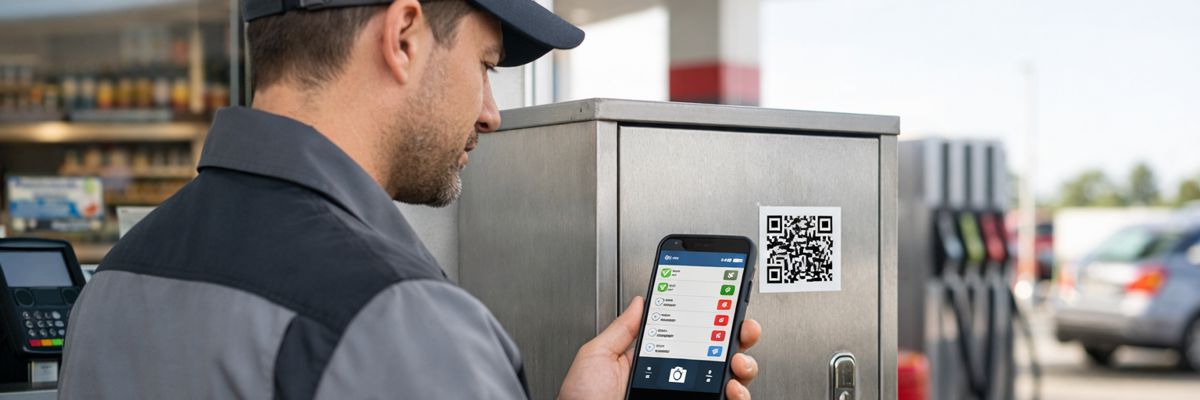
This case study describes how a fuel retail company implemented QR asset tracking for a gas station network to standardize inventories across a large number of remote sites, reduce manual effort, and keep the process reliable even with unstable connectivity. The project focused on operational practicality: clear identification of assets, fast on-site verification, and centralized visibility for the head office.
Client Profile and Scale
The client operates a nationwide fuel retail business with roughly 100 gas stations (structural units) distributed across multiple regions, many of them far from the central office. Each station includes:
- critical technological equipment supporting fueling operations
- office equipment used by station administration
- a retail store with its own trading infrastructure and devices
The inventory load is significant: the client manages 2,000+ asset units per site, which makes traditional manual inventories slow, inconsistent, and error-prone.
Initial Challenges
Before implementation, asset control relied on fragmented local practices and inconsistent registers. This created predictable operational risks:
- uneven data quality across sites and different levels of detail
- difficult identification of similar assets (same model across many stations)
- delayed consolidation and reconciliation at head office
- dependency on connectivity, making inventory schedules unstable in remote areas
- limited evidence for disputes or write-offs due to a lack of visual confirmation
For a distributed gas station business, the key requirement was not only “do an inventory,” but to ensure it can be repeated consistently, under real working conditions, and produce comparable results across all stations.
Business Requirements
The company defined a clear set of requirements for the solution:
- full-cycle asset inventory for technological and office equipment, plus retail store equipment
- support for a large number of remote sites with centralized oversight
- the ability to conduct inventories without Internet and sync later
- photo capture for easier identification and faster verification of disputes
- use of standard smartphones on Android and iOS
- a corporate (on-premise) deployment hosted on the client’s own server
- stable mobile operation despite unreliable mobile data connections
Solution Delivered
The project implemented a unified process based on a simple but powerful chain: asset register → QR label → mobile verification → synchronization → consolidated reporting. The system was deployed as a corporate edition on the client’s infrastructure, ensuring data control and alignment with internal policies.
What was implemented and configured in the system included:
- a standardized structure of organizational units (each gas station as a dedicated unit)
- asset categorization rules and identification standards
- asset cards with consistent attributes per asset type
- QR label generation directly from the system and printing for field deployment
- mandatory photo evidence options in the mobile workflow
- mobile apps for Android/iOS designed to remain usable with intermittent connectivity
Implementation Approach
The rollout was designed to minimize disruption and ensure repeatability. A typical deployment sequence was followed:
- corporate server deployment and access role setup for head office and stations
- preparation/cleanup of the asset register and standardization of asset card fields
- generation and distribution of QR labels, followed by on-site tagging
- configuration of the mobile workflow for intermittent connection and offline execution
- training for station staff and head-office controllers on verification rules, photo capture, and handling discrepancies
- pilot on selected stations, then expansion to the full network once the process was stabilized
The key operational emphasis was creating a “single way of working” so results would be comparable across 100 stations, regardless of region or staff turnover.
Inventory Workflow in the Field
The inventory process was designed to be fast for station teams and transparent for the central office. In practice, the workflow looks like this:
- a responsible employee scans a QR label using the mobile app
- the system confirms the asset identity instantly and displays the asset card
- the employee validates the status (present / discrepancy) and captures a photo if needed
- in areas without connectivity, the app continues to record actions locally
- once a stable connection is available, results are synchronized to the corporate server
- head office receives consolidated results and a discrepancy list for review and follow-up
This approach makes QR asset tracking for a gas station network resilient: inventories are not blocked by connectivity issues and do not depend on manual spreadsheets or ad-hoc lists.
Business Value and Practical Outcomes
The project delivered practical control improvements without relying on unrealistic assumptions. The most important outcomes for the client were:
- faster inventories due to QR scanning instead of manual list searching
- fewer identification errors for similar equipment thanks to QR labels and photo evidence
- stable execution in remote areas through offline operation with later synchronization
- improved central visibility: consolidated results across all stations in a consistent format
- stronger auditability and easier dispute resolution through photo-supported verification
Key Takeaway
For fuel retail networks, asset management success depends on two factors: standardization of data and independence from connectivity at the station level. By combining on-premise deployment, QR labeling, mobile execution on Android/iOS, offline capability, and photo evidence, the client established a repeatable, scalable process for QR asset tracking web application for a gas station network—built for real operational conditions, not ideal ones.